
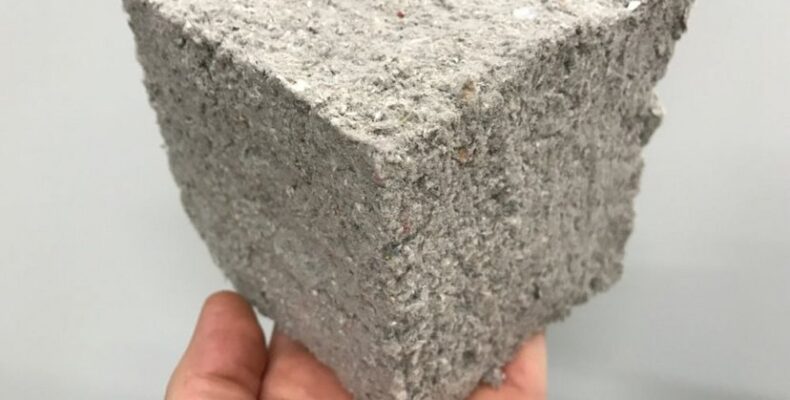
A Swiss manufacturer, in collaboration with researchers, has developed a dimensionally stable and therefore fire-resistant blown-in insulation material made from recycled paper. The product could give new impetus to the use of recycled paper insulation, as cellulose fibers are considered particularly sustainable.
The use of cellulose for building insulation became widespread in Western industrialized nations in the 1970s, particularly in the USA, where rising heating oil prices increased the demand for cost-effective thermal insulation materials. It has been used for insulation in Switzerland since the 1980s. However, this natural insulating material remained a niche product for a long time.
This has changed in recent years. Sales have increased significantly. According to a market analysis by the consulting firm Interconnection Consulting, the Swiss thermal insulation market grew by 4.2 percent in 2019, generating a sales volume of 330 million Swiss francs. Mineral wool (42.3 percent share) and rigid polyurethane foams (15.4 percent) are currently experiencing the strongest growth in terms of value. At 7.8 percent, the market share of cellulose and other natural fibers (excluding wood fibers) is comparatively modest. However, compared to other markets such as Germany, where the share is only 1.8 percent, alternative insulation materials are quite popular in Switzerland.
The most important growth driver is the timber construction industry, which benefits from changes in fire safety regulations. Because insulation materials made from paper fibers are primarily used in this sector, sales have increased following the implementation of new regulations: for example, the construction of multi-story timber buildings was permitted in 2005; and with the 2015 revision, the legislature allowed timber for all building categories.
Most sustainable insulation material
Cellulose flakes are used to insulate roof, wall, and ceiling cavities. The insulation material is made from sorted newspaper, which is mechanically shredded into flakes, treated with flame retardants, ground, impregnated, and finally loosened and compacted. Depending on the supplier, the recycled paper content of the finished product ranges from 75 to 90 percent.
Cellulose fibers have low thermal conductivity and offer excellent summer heat protection. Furthermore, cellulose is inexpensive. According to a compilation by the Swiss energy consulting portal Energieheld, cellulose has one of the lowest prices per square meter after wood fiber and is similarly affordable to expanded polystyrene.
But the material scores highest in its environmental footprint: No other insulation material has a higher recycling rate and a lower primary energy consumption, making it the most sustainable of all insulation materials used in buildings. Because the fiberization process is very simple and paper offers little resistance, its production requires little energy, explains Michel Alder, Managing Director of the manufacturer Isofloc AG. According to the KBOB database for public buildings, the company, founded in 1980 and based in Bütschwil, St. Gallen, is the supplier of the most sustainable insulation product in Switzerland. Paper-based insulation accounts for 60 to 70 percent of its sales and is one of its main products.
Problem of setting
CEO Alder confirms the rising market demand for cellulose. To continue meeting this demand, Isofloc partnered with the Swiss Federal Laboratories for Materials Science and Technology (Empa) on a two-year Innosuisse industrial project. The goal was to develop a dimensionally stable and fire-resistant blown-in insulation made from recycled paper for prefabricated timber construction.
For this, a binding agent had to be found that met two requirements: It had to be demonstrably non-toxic, inexpensive, and available in large quantities. A binding process also had to be developed because the flakes needed to flow well when blown in, but bond firmly within the cavity.
Polymer chemist Thomas Geiger from Empa's Laboratory for Cellulose and Wood Materials explains why gluing is so important: "The recycled paper flakes are filled into prefabricated wooden compartments, which are then sealed by screwing on a wooden backing plate. This causes the material to compress slightly, giving it a certain degree of inherent stability. However, the assembly, loading, and transport processes subject these complete walls to vibrations. This can cause the flake filling to settle slightly, resulting in new voids within the wooden structure."
Dimensional stability through bonding
The process of compaction of the filling material is called settling. Preventing this was the focus of the project. The aim was to achieve improved fire ratings. "The compartments are completely filled with the insulation material. However, if settling occurs during production, a chimney effect can occur in the event of a fire, allowing more oxygen to enter and fan the flames," explains Geiger. "But if the structure is reinforced with a binder so that the filling remains stable and without voids in the compartment until the element is fully assembled, there are no voids in the event of a fire, thus eliminating the chimney effect and effectively providing fire protection."
Geiger's task, and that of his laboratory colleagues, was to find a suitable substance. In a series of experiments, around 40 different additives were tested. A substance from the food industry ultimately demonstrated the desired property in adhesive tests at Empa and in pilot tests in the Bütschwil production hall: a reliable bond between the cellulose structure, even in the event of a fire.
Finally, the flakes were blown into test wooden frames and exposed to a flame of up to 1000 degrees Celsius for an hour in the fire laboratory. The result was that the new insulation withstood the fire test. The exact substance remains a trade secret for now.
Tinkering with the injection method
Isofloc Managing Director Alder is highly satisfied with the result: "The binder ensures that the fiber cube remains within the cavity and results in a secure bond. Thus, the insulation material remains as a whole cube within the structure and provides active fire protection."
Now the product needs to be further developed in terms of application and machine technology to make it suitable for mass production, which requires plant engineering trials. Mechanical engineers are currently building a new generation of blowing machines. The dosage of the binder is crucial: "While the standard cellulose product is being applied, the binder must simultaneously be injected at the inlet of the blowing nozzle to create a bond between the wooden structure and the cellulose," explains Alder.
The engineers are currently working on fine-tuning the system. The main challenge is ensuring that the nozzles always spray the same amount of adhesive onto the loose insulation material.
Boost thanks to timber housing construction
Michel Alder expects the new development to result in ten to fifteen percent more economical application, particularly in the rapidly growing multi-story residential construction sector. He is confident that the new product will be a milestone and generate additional double-digit growth.
Isofloc already collaborates with large timber construction companies. In the "Sue & Til" development in Winterthur, completed in 2018 – the largest timber-built housing estate in Switzerland to date – Isofloc filled the roof and wall elements with cellulose insulation. And in the "Lokstadt" construction project in the same city, the company will also insulate a residential building with recycled paper.
The trend towards sustainable building is being fueled by the current climate debate. Thomas Geiger is convinced that it will ultimately lead to a change in thinking. "Natural materials and sustainable materials that come from certain cycles and are CO2- neutral are becoming increasingly important."
And they are well on their way. Paper flakes are a genuine alternative to petroleum-based insulation products, says the specialist from Empa, adding: "If you consider the entire process, from forestry to cellulose production and paper use, right through to recycling, you have a cycle that is truly sustainable. And as insulation material, waste paper remains in the building for a very long time, potentially over 50 years, until the building is demolished, remodeled, or renovated."
Antonio Suarez / September 14, 2020