
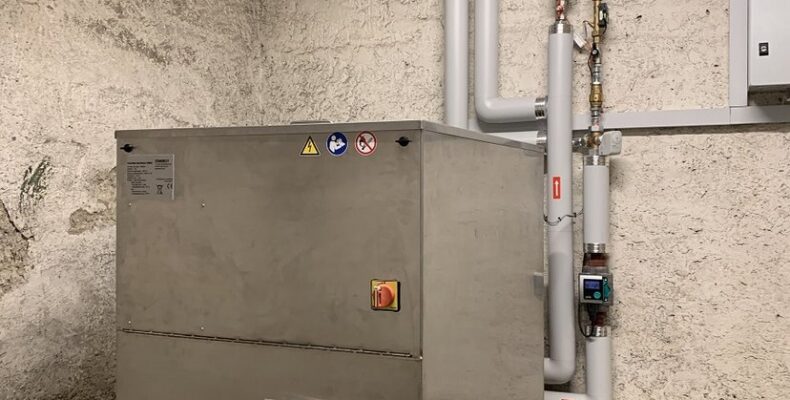
In Basel, the waste heat from a mini data center provides space heating and hot water for an apartment building. This innovative "server heating" system works by bridging the gap between the interests of IT customers and building owners.
Since October 2017, the Canton of Basel-Stadt has had one of the strictest cantonal energy laws. Oil and gas heating systems on cantonal land are to be replaced by heating systems using renewable energy sources wherever possible. This requirement is causing headaches for many homeowners. Heat pumps or pellet heating systems are often difficult to implement in urban areas, and by no means all Basel neighborhoods can rely on a connection to the district heating network. This is also the case in the Neubad district, located west of Basel Zoo. Here stands an apartment building constructed in 1932, which was heated with gas until the 2019/20 heating season. The old boiler is still in the basement, but now only serves as a backup and to cover peak loads. The new heat generator is housed in an inconspicuous stainless steel box. The nameplate reads "chaudière numérique" – digital heating. Indeed, the heat here is not generated from oil, gas, or wood, nor is it extracted from the ambient air or the ground. Rather, the new heating system utilizes the waste heat from several computers. However, the enclosures don't house ordinary PCs, but rather high-performance servers that perform significantly more calculations and therefore generate much more heat than standard computers.
In-demand cloud
“These kinds of server heaters have been around for a few years,” says Stephan Février, the responsible project manager at the Basel energy supplier IWB. A colleague gave him the idea to launch a pilot project: “He works in the IT sector and has numerous servers in the basement of his house. These produce a lot of waste heat, and so he asked me, half-jokingly, if it could be used for heating.”
In fact, the use of waste heat from servers has been a topic of discussion for quite some time. In Switzerland, several large residential areas are heated using waste heat from data centers. However, such solutions have so far only existed on a very large scale. The major advantage of the Basel project is its small size. Decentralized data centers and decentralized heating requirements are a good match. This is also related to the widespread use of cloud technology.
The term "cloud" (more accurately "cloud computing") has been around since the early 2000s. It refers to IT resources, particularly storage and computing power, that are not tied to a specific location such as a physical data center. Instead, these tasks are distributed across various locations or data centers and offered to users via a network connection. The major advantage of this technology is its scalability. Even the largest demands for computing power or storage space can be met by the cloud. However, a significant drawback is data privacy. Digital data is subject to the laws of the country in which it is processed. Due to the geographical diversity of the cloud, data that appears to be hosted in Switzerland can inadvertently end up in the EU or even the USA.
Safe and green
The French provider Neutral-IT, with whom IWB is collaborating on the pilot project, solves this problem with decentralized data centers located in Switzerland. One of these is the server heating system. The data hosted or processed on it never leaves Switzerland, thus ensuring consistent data protection. The package is rounded out by a 100% renewable energy supply from IWB. "This is attractive for IT customers because it reduces their carbon footprint and ensures compliance with Swiss data protection laws. For our customer, the offer is also worthwhile because they don't have to worry about server capacity," explains Stephan Février. "The servers are always running at full capacity, which also means there's enough heat available for heating and hot water."
Inside the stainless steel housing are up to a dozen "blades." These are the modules on which, for example, a server or a switch (network distributor) is mounted. The blades are surrounded by an oil bath. The heat from this bath is transferred via a heat exchanger to a combined storage tank in the adjacent room. This tank heats the water for the central heating system and also supplies a domestic hot water station. This station uses the hot water from the storage tank to heat cold water on demand. This allows hot water to be prepared precisely as needed and with maximum efficiency, instead of having to store it for hours in a large tank. The existing heat distribution system, including the radiators, was retained. For the time being, the renovation work was limited to the technical rooms in the basement. The tenants will only be affected by the removal of the old electric boilers on each floor.
Simple implementation
Converting the heating system was straightforward thanks to the ample space. Before the gas heating system was installed, the building had previously housed an oil heating system. "The old tank had never been touched. We removed it, allowing us to use the former tank room for the server heating system," explains Stephan Février. The new storage tank and the fresh water station easily fit into the adjacent room. Février believes this will improve comfort for the tenants: "They'll have more space in the bathroom because the old boilers are being removed."
For homeowner Stefan Eugster Stamm, the pilot project is also worthwhile: “Within a few years, we owners in the neighborhood will have to find a replacement solution for fossil fuel heating systems. Installing a pellet or heat pump heating system would have required me to adjust the insulation and heat distribution. With the server heating system, I gain another five to eight years to start planning for that.” The building's tenants, mostly young, were kept informed about the entire project progress and, according to Eugster Stamm, appreciate the new heating system: “They think it's great to already be living in a building with CO2-neutral heating.” The project is also financially advantageous: Despite the innovative technology, the costs for the homeowner are roughly the same as continuing to operate the conventional gas heating system.
A new alternative?
Suissetec also recognizes the potential of small-scale IT waste heat recovery. Robert Diana, Head of Heating Systems, raises a few points for consideration: "Residential buildings are expected to have a lifespan of at least 50 years. A conventional heat generator should therefore last at least 15 years. If the technology for a stand-alone solution like mini-server heaters becomes unavailable in 5 or 10 years, a utility company like IWB can certainly find an alternative. However, private owners could run into difficulties if the lifespan of the components is too short."
No one can yet predict what role server heating will play in a few years. Stephan Février from IWB, however, is convinced of the technology's potential: "Server heating is a great alternative to pellet heating systems or heat pumps. This is particularly interesting for neighborhoods not connected to the district heating network." Although the pilot project is currently underway in an urban area, the technology is not intended to be offered only in Basel. "We are already receiving many inquiries from all over Switzerland," reports Février, "which is why we want to offer the product nationwide." Plans include both contracting, i.e., a "flat-rate heating" service including operation and maintenance, and systems operated by the building owner. Therefore, housing cooperatives don't necessarily have to wait until a data center is built nearby – they might even be able to bring it into their own buildings.
Further information is available at www.iwb.ch/serverheizung