
Sustainable solutions for heat generation are more in demand than ever. Energy from renewable resources is essential right now. Standardized, small wood pellets are very much in vogue when it comes to renewable energy. And they're actually a Swiss solution.
Especially in older buildings with flow temperatures between 75 and 90 °C, solutions using natural and low-CO2 raw materials as heat transfer fluids should definitely be considered in energy efficiency analyses. For example, to operate a heat pump economically, significant sums must be invested in renovating the building envelope. Reducing flow temperatures would require increasing the surface area of radiators, which would also be very expensive. Therefore, pellet heating is a very good alternative. Existing utility rooms typically offer enough space for a complete pellet heating system.
Example of a renovation of a historic building
Historic buildings are aesthetically pleasing and exude a touch of the charm of bygone days. And that's all well and good – until renovations are needed. Then, not only are high costs involved, but heritage protection and historic preservation regulations also have a significant say. When evaluating a new heating system, one becomes acutely aware of the challenges posed by old buildings. But even for buildings worthy of preservation, there are ideal solutions. Such as in this example of a hotel over a hundred years old in central Switzerland.
When the periodic oil tank renovation and further investments in the building infrastructure became necessary, the time was right to finally say goodbye to fossil fuels. The location directly on the lake would have initially suggested a water-to-water heat pump. However, in historic buildings with poor insulation, system temperatures are usually high, making a heat pump uneconomical to operate. The choice fell on wood, a renewable and CO2-neutral fuel. Since a hotel requires a highly reliable heating system, ultimately only a pellet heating system met the complex set of requirements.
New use of space
The oil tank, with a capacity of several thousand liters, was housed in a separate room next to the utility room. This gave rise to the idea of relocating the pellet silo outside the hotel complex and converting the freed-up space into a fitness studio for guests. Today, the silo stands against the exterior wall of the boiler room and can be easily filled at any time by the pellet tanker truck. The silo has a volume of 22 m³ or 15 tons of pellets, which corresponds to a six-month supply. The existing stone chimney was demolished, thereby expanding the available space. The elegant new stainless steel chimney, color-matched to the building, requires little space and in no way detracts from the hotel's picturesque appearance.
Easy maintenance – good for the environment
Heating boiler specialists like Windhager and Meier Tobler have years of experience with pellet heating systems and offer excellent products. These systems are equipped with proven combustion technology, achieve the highest efficiency ratings, and are very user-friendly. Burners with state-of-the-art technology ensure an optimal combustion process with a stable bed of embers. Efficiencies of up to 98% can be achieved, and particulate matter emission limits are significantly undercut. The high technological standard of the combustion technology enables virtually ash-free combustion and guarantees trouble-free operation even with fluctuating pellet quality. The reliable operation of modern pellet boilers is comparable to that of oil or gas boilers – only much more environmentally friendly.
Do these little energy wonders really come from Switzerland, or is the raw material delivered from distant forests? A conversation with Peter Lehmann, Head of Sales at AEK Pellet AG, Balsthal, provides insight into the domestic production of this wood-based fuel.
Pellets “Made in Switzerland”
AEK pellets are produced in-house using locally sourced wood. Only sawdust, shavings, and wood chips, delivered from regional sawmills and timber companies, are processed. This ensures high local value creation. Pellets are highly environmentally friendly, CO2-neutral, and the raw material is renewable. They are more resilient to crises and less dependent on the international fuel market. As a product of domestic value creation, pellets meet the expectations of the Swiss population, and the short transport routes are economical.
Pellets have a high calorific value of approximately 4.8 kWh/kg. The annual requirement is about 400 kg per kW of heating load. In short: It's the most convenient way to heat with wood. The energy required for pellet production is about 3% of the pellets' energy content (heating oil approx. 15%).
The idea for pellet production was sparked by the devastating storm "Lothar" in 1999. The uprooted trees had to be put to good use. Today, AEK Pellet AG is the market leader with a production of over 60,000 tons. This amount is enough to heat 12,000 single-family homes.
How these little energy miracles are created
Moist wood chips are dried and shredded. Before the dry sawdust is processed into pellets, it undergoes another quality control check. It must be bark-free, and its color, smell, and moisture content must be correct. The raw material then enters the production hall. Spruce and fir wood are very well suited for production and are available in large quantities in Swiss forests. The raw material is stored in a buffer tank, and from there a conveyor belt transports it to the magnetic and heavy particle separator. Anything that doesn't belong in the wood pulp is removed here. The material then moves to the hammer mill, where 132 hammers, rotating at 3,000 revolutions per minute, grind the material to the required fineness.
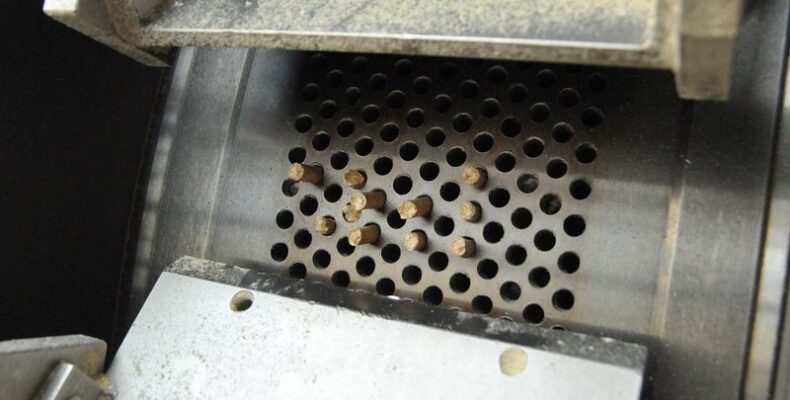
The three presses each have a throughput of 4 tons per hour. The perforated die ring determines the shape: The finely ground raw material is heated to around 100 degrees Celsius and pressed through the die. The heat dissolves lignin, a natural adhesive in the wood, binding the wood particles and thus solidifying the pellets. The natural, glossy coating around the pellet also provides protection. At the end of the die ring, the pellets are cut to standardized lengths. Quality is monitored throughout the entire production process, and samples are taken hourly.
Proper storage
Proper pellet storage plays a crucial role in maintaining pellet quality. Correct ventilation of the storage area is also essential. If a fuel storage room already exists, for example, during a conversion from oil to pellets, it can be converted into a pellet storage room. The room's volume is usually sufficient for the required quantity of pellets during a renovation. Textile silos, for instance, can be used. This type of storage offers maximum spatial flexibility. They are easy to install and require no special structural modifications. A flexible, air-permeable, yet dustproof and antistatic fabric ensures optimal storage and dust-free delivery. Depending on fuel requirements, silos with capacities of up to 12 tons of pellets are available.
The full article was published in p+i 01/22