
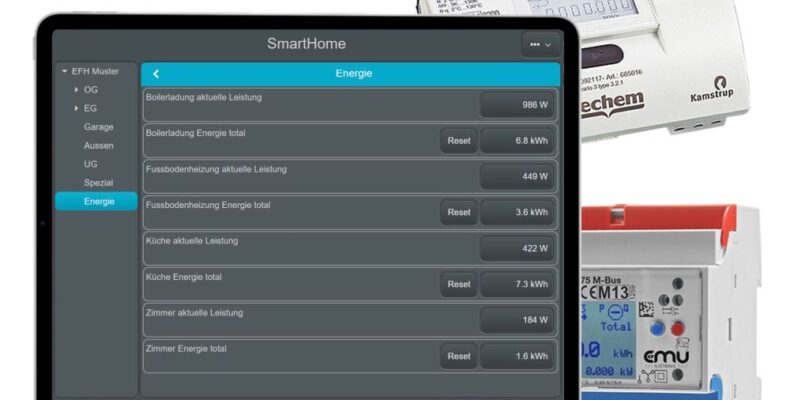
Für Smart-Living-Konzepte reicht die Automation, die das Leben zu Hause einfacher und sicherer macht, nicht mehr aus. In der Krisenzeit ist die Steuerung der Energieflüsse und damit der Rundumblick in den Fokus gerückt.
For a long time, smart technology was dominated by intelligent entertainment systems, remote-controlled door locks, and blind and heating controls, ideally via voice assistants. However, with the risks that have become visible everywhere in the energy crisis over the past year, new demands have gained considerable traction. This is evident, for example, in the surge in demand for real-time power management tools. Rising energy prices are a major factor driving the need for improved energy efficiency and ways to reduce electricity and heating costs. Interestingly, manufacturers and installers alike agree: Awareness of energy consumption has increased significantly. This is a trend observed at Wahli, the Bern-based provider of the Twiline smart home system, as well as at ISP Electro Solutions in Ostermundigen, which installs building automation and photovoltaic systems in addition to electrical installations in the canton of Bern.
Urs Wenger, Managing Director of Wahli, a specialist in smart home and building systems technology, elaborates: “After years of focusing primarily on comfort, the current shift is towards energy optimization. This mainly involves configuring or retrofitting individual components to reduce the house's energy consumption in some way or to optimally integrate newly added alternative energy sources.” While this doesn't change the three main motivations for implementing a smart home – increased comfort, improved security, and reduced energy consumption – it's important to distinguish between owners of a Twiline smart home system and new projects.
According to Wenger, "energy management is now a much stronger focus from the outset in new installations or major renovations. The aim is to control energy consumers and prioritize them. An important aspect of this is the optimal use of self-generated energy and the reduction of grid consumption," says the Wahli CEO. Because they had already addressed this issue earlier, the impact of the energy crisis was not very significant. "An important part of the adaptation process is internal training and the provision of suitable functional modules within the system," he adds.
Training and technical system development
When asked about new technologies related to the energy crisis, Wenger points to process optimizations, such as the energy-optimized individual room temperature control. He illustrates the possibilities by explaining that if a room is heated with self-generated energy, such as solar energy via a heat pump, it can be overheated by 2°C. This excess energy can then be used when switching to grid-connected heating. "Or the hot water storage tank can be heated to a higher temperature using self-generated energy (including legionella protection), and the temperature is set just below the required level when the system is connected to the grid," he adds. He also notes the increasing importance of prioritization technologies: "These define whether a consumer can be switched on even when drawing energy from the grid, or only when self-generated, and they also allow for prioritization between different consumers." Wenger explains that for Wahli, implementing these two areas meant selectively expanding their in-house system and simultaneously developing the expertise of their customer service representatives in this direction.
In addition to internal training and development, the system is naturally continuously expanded and optimized in several areas. According to Wenger, this includes functional enhancements as well as the integration of new technologies, modern user interfaces, and optimizations for the integrator. However, he notes that "energy-related aspects are certainly given higher priority today compared to the past." It's important to remember, though, that the systems are becoming increasingly complex and resource-intensive. "As a system manufacturer, it's a major challenge to make the specific parameterization of each individual system simple and understandable for the system integrator, while simultaneously presenting the full complexity of the topic in a way that non-expert users can easily grasp." And, Wenger adds, "the better the process optimization and prioritization are implemented, the less support is needed.".
Sensitivity regarding energy is growing
Philippe Burkhalter, Deputy Head of Technology at ISP Electro Solutions in Ostermundigen, also points out that nowadays "almost everyone involved in planning a home, whether it's a condominium or a single-family house, considers smart home solutions at some point during construction." Currently, this is primarily the homeowner, but overall, Swiss residents have become much more energy-conscious in light of all the crisis scenarios during the energy crisis. "Therefore, the topic of photovoltaic systems is at the top of the list for every new build or renovation. This raises the question of how the energy should then be distributed and managed within the building. Our smart home solutions can monitor and control energy flows, thus increasing self-consumption," Burkhalter outlines the recent changes. He goes on to mention – like Wenger – the smart home hub, which supplies energy to the consumer when needed: "In most cases, self-consumption of solar power is still more attractive than feeding it back into the grid." Prioritizing this can be implemented with an automation system, Burkhalter adds.
Therefore, comprehensive solutions
The ISP expert sees a handicap in controlling energy flows in all solutions that only address parts of the building: "There are many do-it-yourself solutions for controlling lights and heating. These usually do what they're designed for, but can't be used for energy management, for example." A comprehensive solution, on the other hand, is able to connect all parts of the building and thus control them optimally, says Burkhalter. The goal is to be able to control everything in the home via a single app. Specifically, this starts "with the photovoltaic system, continues with the charging station for the electric car, which, for example, is only charged with surplus energy from the photovoltaic system and, if necessary, also uses energy from the storage system in the basement. Lighting, shading, and heating are also integrated into the system. With the help of weather data and the weather station, damage to blinds and awnings can be prevented." We also supply a surveillance system to prevent break-ins, as well as an alarm system that calls for help if a resident has fallen and is unable to call for help herself
Despite skepticism, dare to try new things
Despite all this, Burkhalter doesn't deny that some people are hesitant to let even more technology into their lives and are consciously seeking simplicity again. Others, however, see the benefits and convenience of a smart home and are striving for a suitable solution. They have moved beyond the image of a smart home where one is constantly "walking around the apartment with a tablet and letting the system tell them what to do," the ISP specialist continues.
Today, optimizing self-consumption of self-generated energy is at the top of the list. "The building itself decides when it's best to feed the produced energy back into the grid, or whether to start the washing machine or charge the electric car first." Furthermore, there is increasing demand for bidirectional charging of electric vehicles, which is already feasible today but still presents many challenges and uncertainties. However, Burkhalter is optimistic: "It's only a matter of time before this becomes standard practice in single-family homes." Then, the electric vehicle will not only draw electricity from the grid as usual, but the energy from the vehicle's battery will also be fed back into the grid or into the house. It remains to be seen what impact this form of energy use and storage, as envisioned by smart home system manufacturers and their installers, will actually have on the energy transition.